Publication
The Book
The Periodic Table of Human Self.
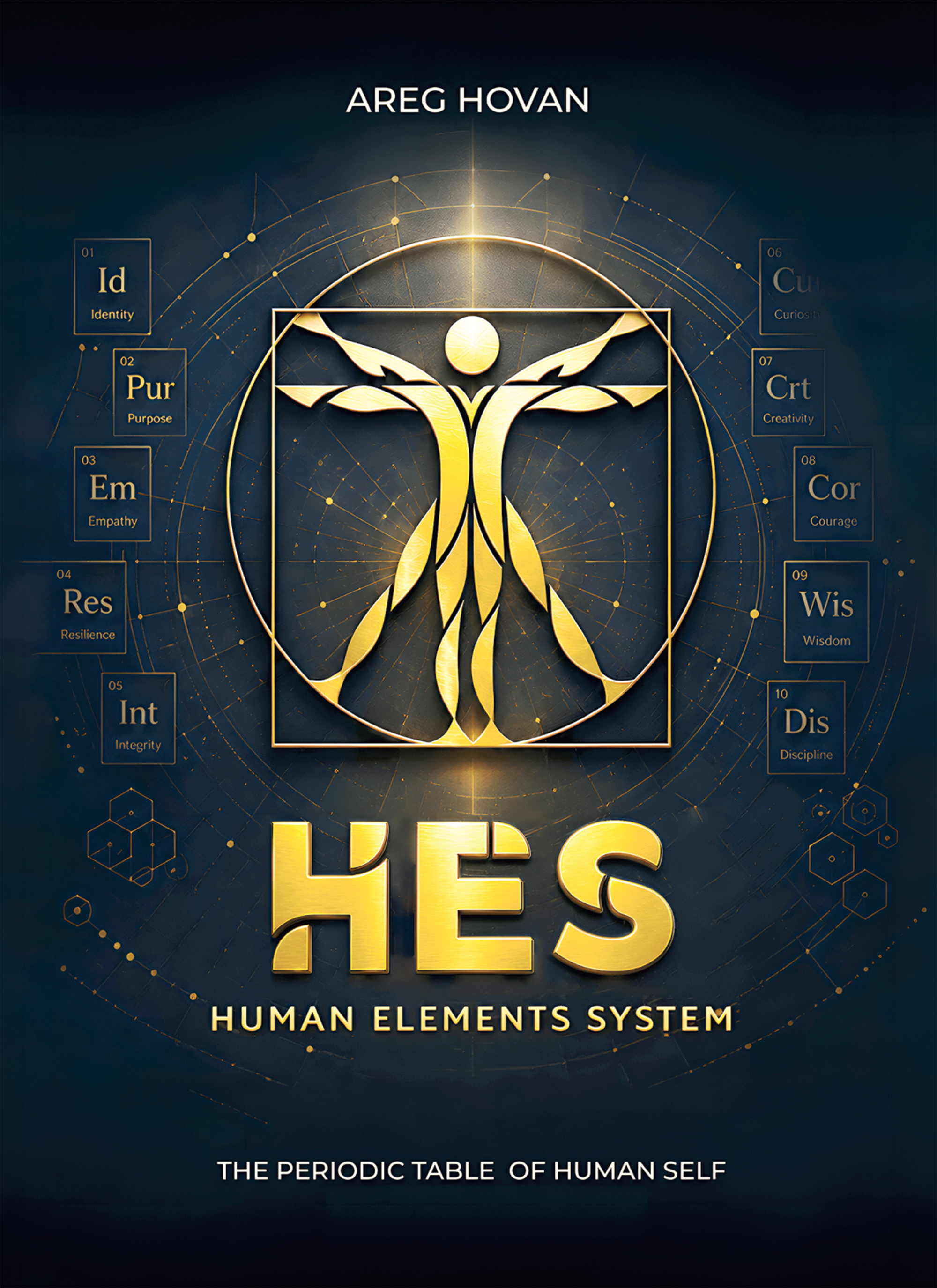
HES — Human Elements System
The Periodic Table of Human Self
Areg Hovan
People are different. But different in what — and by how much? We can photograph a black hole fifty-five million light-years away. We cannot weigh a mood.
The same species that synchronizes atomic clocks across twelve thousand kilometers still fires a CEO for "a deficit of emotional intelligence" — a phrase no one can define, measure, or test. We built telescopes of impossible power and barely thought to build a mirror.
The Human Elements System (HES) is that mirror: a periodic table for the inner world. 343 elements of human nature, organized across four layers:
Core — the hardware you're born with. Derived — the software you install. Quantum — the crash states you fall into. Emotional — the weather that passes through.
Every element is defined precisely, placed on a clear axis, and graded on a five-level scale for how well it can actually be measured today — from qualities testable right now to those HES has named before the instruments exist.
This is not a personality test. It will not sort you into a type or promise to reveal your hidden self. It does something rarer and more honest: it draws the map first, marks which territory science can already reach, and admits which parts are still fog.
Mendeleev's table came before modern chemistry. Linnaeus's taxonomy came before the theory of evolution. The map comes before the instruments. The name comes before the number.
The inner world does not have to stay a kingdom of fog. This is not a finish line. It is a starting gun.
Contents
- IntroTelescopes Without Mirrors
- 01People Are Different. But Different How? And How Much?
- 02A Map Instead of Labels: How HES Works
- 03Core: The Infrastructure You Run On
- 04Derived: The Software You Install
- 05Quantum and Emotional: When the System Shifts
- 06The Lines on the Map
- 07HES Lingua: The Map Across Languages
- 08What HES Makes Possible
- ClosingClosing Word
- A–GAppendices A–G
Sample Chapter
Telescopes Without Mirrors
On April 10, 2019, a team of over two hundred scientists released the first-ever photograph of a black hole. To get it, they had turned the entire planet into a camera. Eight radio telescopes — scattered across volcanoes, deserts, mountaintops, and Antarctic ice — had synchronized their atomic clocks to within a trillionth of a second, then aimed, together, at a point fifty-five million light-years away.
That same year, the board of directors at a Fortune 500 company fired its chief executive. The stated cause was "a deficit of emotional intelligence." Reporters asked what the phrase meant. The answers were vapor: "communication dynamics," "cultural fit," "leadership style." Nobody could define the term. There was no test. There was no scale. There was a feeling, and someone had pinned a fancy label to it.
Set these two scenes side by side, and something uncomfortable comes into focus. The same species that can synchronize atomic clocks across twelve thousand kilometers to photograph the edge of a black hole cannot agree on what it means to understand another human being. We can weigh a galaxy. We cannot weigh a mood.
For Researchers
╱╱ Academic access
Academic access, citation data, and supplementary materials are available through the research portal.