Measurement Maturity Levels (MML): grading the measurement readiness of psychological constructs
Preprint · PsyArXiv, August 2026 · DOI: 10.31234/osf.io/ujctf_v1
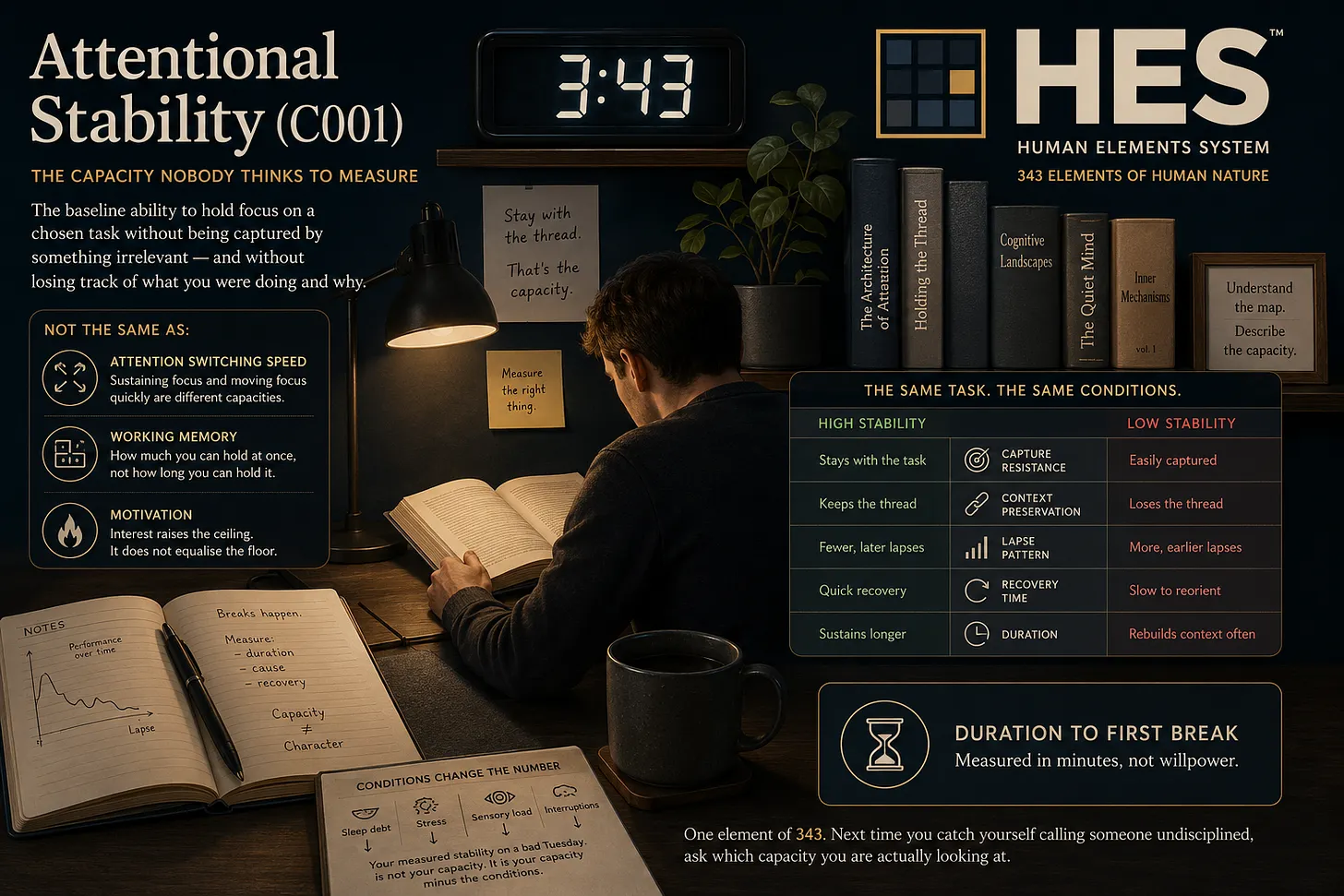
HES organizes 343 traits, skills, states, and emotions into four layers — Core (hardware), Derived (software), Quantum (crash and surge states), and Emotional (weather) — so that the language of human qualities becomes precise, comparable, and open to measurement.
Scroll to learn more
Elements catalogued
Layers of structure
Thematic blocks
MML maturity tiers
HES is a structured reference for the elements that compose human behaviour, cognition and physiology — 343 distinct passports across four layers, from the millisecond reflex to the slow weather of mood. A field guide, not a personality test.
HES is not a personality test, a diagnostic system, or a moral verdict.
It does not tell you whether you are good or bad, healthy or sick, better or worse than anyone else. It is a shared vocabulary for the specific mechanisms that make up a human being — one that can be measured, translated across languages, and revised as the science improves.
The Core layer contains the relatively stable foundation of the human system: processing capacity, sensory thresholds, temperamental baselines, and the biological architecture that everything else runs on. Core qualities change slowly and constrain what the rest of the system can do. Analogy: the processor, RAM, and battery of the system.
The Derived layer contains learned, practiced, and installed patterns that run on top of Core hardware. Derived qualities can be updated, patched, and replaced through training and experience, but they are always constrained by what the underlying hardware can support. Analogy: applications, operating systems, and learned routines.
The Quantum layer contains temporary mode-shifts in which the system’s normal operating parameters change significantly. Quantum states are not traits; they are state-episodes with identifiable entry conditions, characteristic dynamics, and natural resolution patterns. Analogy: blue screen of death, kernel panic, safe mode — or, for surge states, overclocking and turbo mode.
The Emotional layer contains episodic affective programs with identifiable triggers, characteristic outputs, and natural resolution patterns. These are the weather of the human system: transient, recurrent, and context-sensitive. Rain is not a malfunction. Sadness is not a bug. Analogy: the atmospheric conditions that affect visibility, movement speed, and what is possible today.
Every element in HES sits in exactly one layer. The layers are ordered: each one rests on the substrate of the one below it. Core comes first because nothing else runs without it.
A complete reference to the Human Elements System: 343 elements of human nature across four layers — Core, Derived, Quantum, and Emotional — each with a structured passport that defines what the quality is, what it is not, and how well science can currently measure it. Written for anyone who wants to think about people with more precision than everyday labels allow.
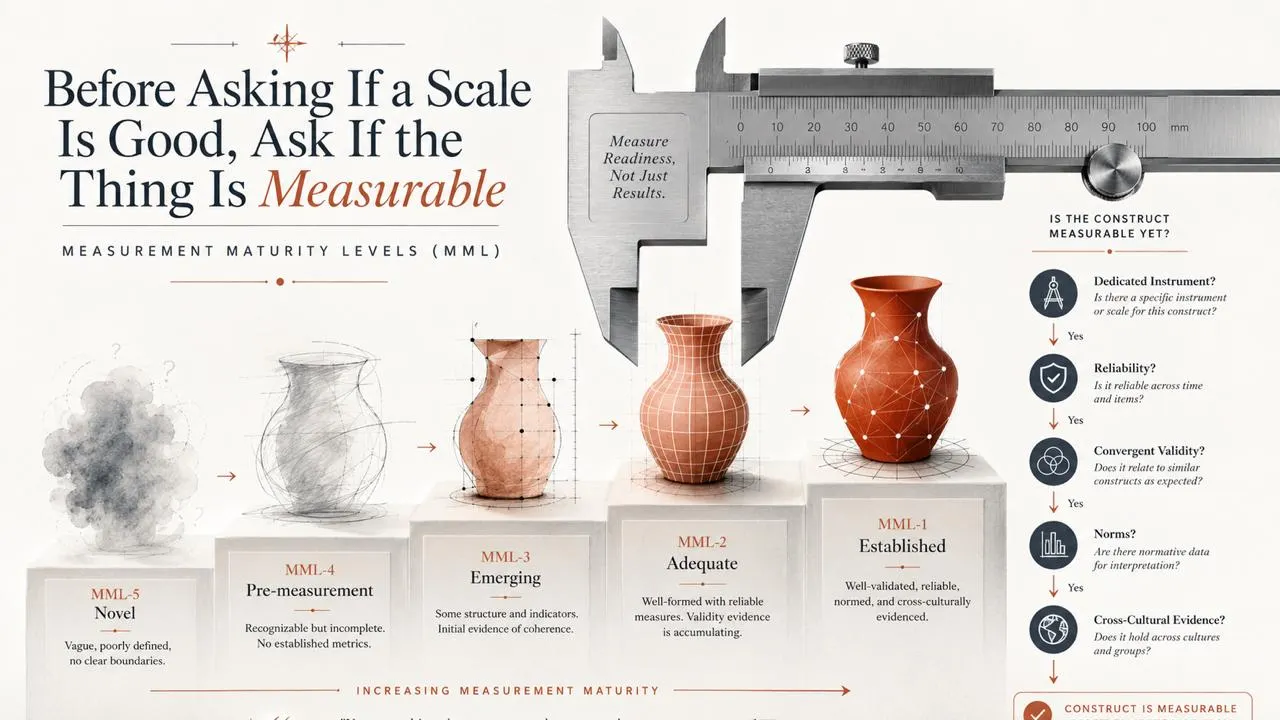
A new paper introduces MML. Some constructs are ready to be measured. Others aren't.

Shame (E019): four emotions we collapse into one word — and why the confusion is expensive.
Not every psychological construct rests on the same weight of evidence. The Measurement Maturity Levels (MML) framework grades each HES element from established to speculative, making both the strength and the gaps of the underlying science explicit — so the reference stays honest about what is actually known.
Measurement Maturity Levels (MML): grading the measurement readiness of psychological constructs
Preprint · PsyArXiv, August 2026 · DOI: 10.31234/osf.io/ujctf_v1
The Human Elements System: Rationale and Structure
In preparation, 2026